
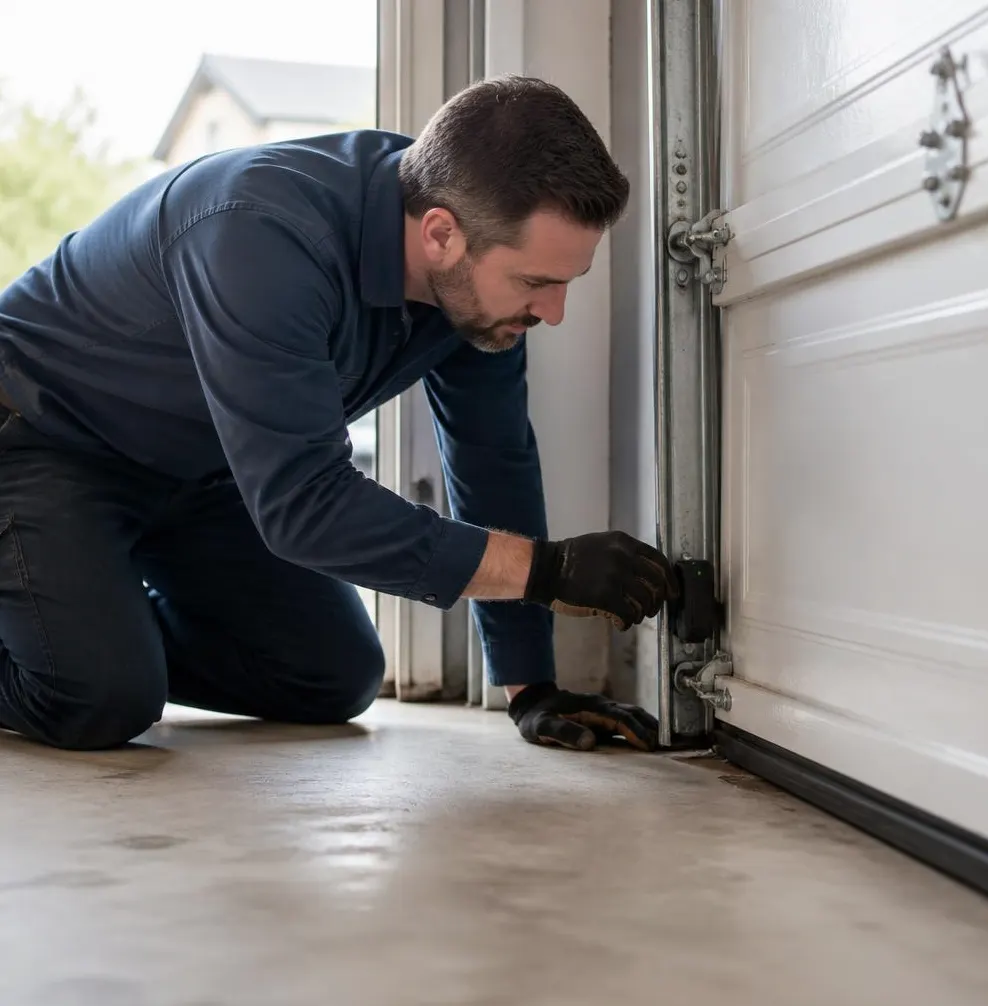
What a Tech Sees After a Windstorm
The calls usually come in the day after a bad blow: a door that looks fine from the driveway but won't open, or one that's visibly bowed outward in the middle like it took a breath and never let it out. Pop the garage open and the picture gets clearer — track pulled away from the wall on one side, a bent top panel, or hinges torn loose from fasteners that just weren't built for the load. On older homes around here, it's often the original hardware, thin-gauge steel from a builder-grade install decades ago, finally meeting a gust it was never rated for. On newer homes, it's sometimes a door that looks solid but was never reinforced after install, so the first real coastal storm finds the gap.
Why the Garage Door Is the Weakest Wall in the House
Every other opening in a home — windows, doors, walls — is a fixed, braced structure. A garage door is a large panel of thin material held in place by rollers, tracks, and a spring system, with nothing but friction and a few fasteners keeping it from moving. It's also the biggest single opening in most houses, often 16 feet wide or more for a two-car door.
When wind hits a house, pressure builds on the windward side and drops on the leeward side. If the garage door fails — buckles, blows in, or gets sucked outward — that pressure differential suddenly has a path into the house, and the uplift can affect the roof structure from the inside. That's the mechanical reason insurers and builders pay attention to garage doors in storm-prone regions: it's not just about the door, it's about what happens to the rest of the house once that opening fails.
Why This Matters More Here
The Eastern Shore gets a mix of conditions that stress a garage door differently than most of the country sees in one year: humid summers that keep seals and hardware damp, heavy rain and coastal storm systems that bring sustained wind rather than a single gust, and icy winters that stiffen springs and make tracks less forgiving right when a cold front also brings wind. A door that's marginal in July can fail outright in a February storm because the hardware is already working harder in the cold.
A Practical Pre-Storm Checklist
- Check the track-to-wall fasteners. Give the vertical tracks a firm push by hand. Any flex or visible gap between the bracket and the framing means the fasteners are loosening — a common issue on older housing stock where the original screws have worked loose over years of door cycles.
- Look at the panels themselves. Run a hand along the inside of each panel. Thin, unreinforced steel panels will flex noticeably under light pressure. If yours does, horizontal reinforcement struts (steel bars bolted across the inside of each panel) are a straightforward upgrade that significantly stiffens the door against wind load.
- Inspect hinges and rollers. Cracked hinges or rollers with chunks missing from the wheel are weak points that give way first under added stress, not just on the smoothest cycle.
- Test the weatherstripping and bottom seal. Dried-out or torn seals let wind-driven rain push past the door edge, which is exactly what heavy coastal rain tends to do. This is a maintenance item, not a structural one, but it's cheap to fix and prevents water intrusion that can warp wood-trimmed doors or rust steel hardware.
- Confirm the opener has a battery backup or manual release you can reach. Power outages are common during coastal storms, and a door stuck half-open because the opener lost power is its own hazard.
The Trade-Off Homeowners Should Know
Reinforcement struts and heavier-gauge hardware cost more upfront than doing nothing, but replacing a blown-out door, repairing water damage to whatever the wind pushed inside, and dealing with a compromised roofline after a storm costs far more. For homes on older foundations or with original builder-grade doors, the math tends to favor reinforcing now rather than reacting later.
When to Call Parsonsburg Garage Door
If your door flexes under hand pressure, the track has visible play at the wall brackets, or you're not sure whether your hardware was ever upgraded past the builder-grade original, that's worth a look before storm season, not after. We handle Garage Door Maintenance visits that check tracks, hinges, rollers, and seals, and we can walk you through Garage Door Installation options if your current door is old enough that reinforcement isn't practical anymore. Either way, we tell you honestly which repairs matter and which can wait.
If you're in Parsonsburg, Salisbury, Pittsville, Delmar, Fruitland, Willards, Hebron, or Ocean City and want your garage door checked before the next front moves through, give Parsonsburg Garage Door a call. We show up when we say we will.